English| EUR
Suggested for you
More currencies
Choose a language
Zagreb's culinary identity is written in štrukli dough, cured meats, and the iron-framed stalls of Dolac Market. This guide maps the dishes that locals grew up eating, the morning market where ingredients arrive before dawn, and the streets where those traditions translate to the plate.
Quick answer
Zagreb famous food centers on štrukli—baked or boiled pastry filled with fresh cheese—kulen sausage, sarma cabbage rolls, and the seasonal produce sold at Dolac Market from 07:00 daily. The city's cuisine draws from Austro-Hungarian, Balkan, and rural Croatian roots, with most signature dishes available year-round in traditional konobas and the Upper Town's family-run taverns. Dolac Market operates every day with peak variety between 08:00 and 11:00.
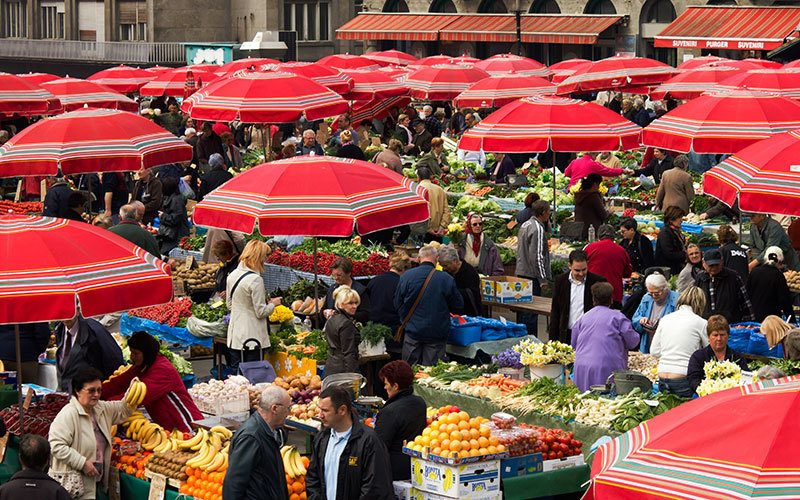
Štrukli earned protected heritage status in 2007, cementing its place as the dish most synonymous with Zagreb's table. The pastry—thin layers wrapped around cottage cheese, sour cream, and eggs—appears baked with a golden crust or boiled and finished with butter, and nearly every restaurant in the Upper Town keeps both versions on the menu. The recipe originated in the Zagorje hills north of the city, but Zagreb adopted it so thoroughly that visitors now treat it as the capital's own. Kulen, a paprika-laced pork sausage from Slavonia, dominates the charcuterie boards in wine bars around Tkalčićeva Street and anchors the cold-cut stalls at Dolac Market. The market itself—operating since 1930 on a plateau above the main square—functions as both ingredient source and informal food education, with farmers selling kajmak cream, fresh horseradish, and bundles of wild asparagus depending on the season. The red-umbrella vendors arrive before dawn, and the selection thins after midday, making morning the undisputed window for serious shopping. Sarma and štrukli share the winter comfort-food throne, though sarma—cabbage leaves stuffed with minced meat and rice—leans more heavily on Balkan tradition. Restaurants serve it year-round, but it peaks in relevance between November and March when the dish's weight matches the season. Cremeschnitte, the vanilla custard slice locals call kremšnita, closes most traditional meals and appears in every bakery case, a direct inheritance from Habsburg café culture that never left. The neighborhoods that preserve these dishes cluster in two zones: the Upper Town's cobbled streets around St. Mark's Church, where konobas occupy medieval cellars, and the blocks radiating from Dolac Market, where working taverns serve farmers, vendors, and early-rising locals before the tourist day begins. Zagreb famous food is not a relic—it is the working menu of a city that still eats what it grew up eating, with Dolac Market providing the daily proof.
“Štrukli earned protected heritage status in 2007, cementing its place as the dish most synonymous with Zagreb's table.”
Zagreb offers a mix of historic market-to-table ingredients and traditional tavern dining. Exploring local konobas and the central market provides the most authentic access to regional staples.
market
This central open-air market is the place to source fresh local produce and cheeses directly from regional farmers. It serves as the primary hub for culinary ingredients in the city center.
restaurant
Located near the cathedral, this venue specializes in various iterations of štrukli, a traditional dough-based dish. It is a dedicated space for tasting both sweet and savory versions.
restaurant
A classic tavern located in the Upper Town serving traditional plates like purica s mlincima and zagrebački odrezak. It focuses on historical Zagreb recipes in a wood-paneled setting.
street
This pedestrian thoroughfare is lined with numerous restaurants and small eateries offering diverse local menus. It is the main concentration of dining options for visitors staying in the city center.
The best arrival window for experiencing the Dolac Market is 08:00–11:00, when vendors display the widest selection of fresh local produce. Visiting during these hours ensures you see the market in full swing before the peak midday activity subsides.
—
Farmers arrive early with seasonal goods, offering a quieter atmosphere for browsing.
Mild 18°C to 23°C
These months offer comfortable temperatures for walking between stalls and food vendors.
Cold 0°C to 5°C
The market features seasonal holiday goods, though outdoor temperatures require appropriate winter clothing.
Warm 25°C to 30°C
Summer produce is abundant, though the market can become crowded by late morning.
Verdict: Tuesday to Thursday, arriving between 08:00–11:00, during May or September provides the most balanced experience for exploring Zagreb food markets.
The Dolac Market area operates daily throughout the week, maintaining consistent hours to serve both residents and visitors.
Dolac Market is located at Dolac 8, 10000, Zagreb, Croatia, situated directly north of the main Ban Jelačić Square. The market area is most easily accessed by walking through the narrow passage from the central square or via the stairs leading up from Pod zidom street.
From Ban Jelačić Square via Pod zidom
Lines 6, 11, 12, or 13 to Trg bana Josipa Jelačića
Drop-off at Kaptol or Ban Jelačić Square
The best arrival window is 08:00–11:00 to see the market in full swing with fresh local produce. For those arriving by car, note that central Zagreb parking is limited and paid, so utilizing public transport is recommended.
Everything you need to know about zagreb famous food
Zagreb famous food typically includes traditional dishes like štrukli, a dough-based pastry with cottage cheese, and various grilled meat specialties. These culinary staples reflect the city's rich history and Central European influence. Many visitors enjoy exploring these flavors on a guided Croatian gastronomy tour.
Dolac Market is the premier location to find fresh local produce, artisanal cheeses, and cured meats. This central hub is where residents purchase ingredients for their daily meals and is a highlight for anyone seeking authentic Zagreb local cuisine. You can also explore these stalls as part of an organized Zagreb city food tour.
The best arrival window is 08:00–11:00 to see the stalls in full swing. This period allows you to experience the vibrant atmosphere and the freshest selection of seasonal goods. Visiting early ensures you avoid the largest midday crowds.
There is a 0 EUR entrance fee for the public area of the Dolac Market. It is a free-access site where you can browse local goods at your leisure without needing a ticket. This makes it an accessible stop for travelers exploring local food landmarks.
Children are welcome at the market, making it an excellent opportunity to introduce them to local culture and fresh produce. The open-air environment is generally easy to navigate, though it can get busy during peak hours. Supervision is recommended given the bustling nature of the market floor.
The market is open daily from 07:00–23:59, ensuring consistent access for visitors throughout the week. This schedule applies every day from Monday through Sunday. Please note that individual vendor stalls may have shorter hours than the market area itself.
A visit to the market usually lasts between 45 and 90 minutes. This timeframe provides enough space to walk through the stalls, interact with local farmers, and observe the daily rhythm of the city. You may find that joining a organized market tour helps structure your time effectively.